
Dear reader, I start this blog post with yet another confession, which is thus: Although I will be talking today about three different variations on Jane Austen’s novel, Pride and Prejudice, I have yet to read the actual novel. Has that ever happened to you? I now have a fear that when I do get to reading the actual novel, my reading of it will be tainted by these three adaptations I’ve read before it. But I suppose, even if I hadn’t read them, I would still be bringing my own ideas, perspectives, and the like to the original anyway, so really is there a way for me to read Pride and Prejudice objectively?
Ironically, I have a hard time reading classics, but yet I have read three adaptation of it. My main problem with classic is I find the archaic language quite distracting, to the point where it almost gets in the way of my physical reading of the story, if that makes sense. But, never fear dear reader, I will read Pride and Prejudice at some point!
The first book I’ll be talking about is an Amish retelling by Sarah Price. The setting being Amish, I felt like this retelling was the closest to the original, what with the getting around by horse and buggy and there being no electricity. This book was actually my first foray into Amish fiction. It was something I found myself avoiding for a long time because I assumed I wouldn’t like it. What a silly thing, our assumptions! Much like regency romance, I have now fallen headlong down the rabbit hole of Amish fiction. Not only have I read other retellings of classic novels by Sarah Price, but I’ve also listened to several Amish fiction audiobooks. What worlds of reading we keep ourselves from simply by assuming we couldn’t enjoy them!
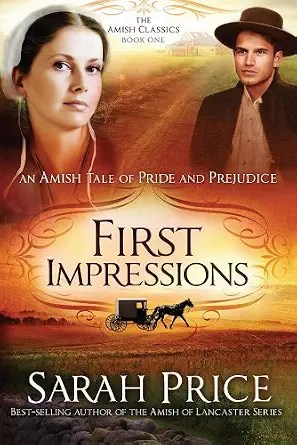
First Impressions by Sarah Price
With five daughters and no sons, Daed and Maem Blank are anxious to find their girls suitors who might eventually take over their family farm. When news arrives that Charles Beachey, the son of a prominent Amish farmer, will be returning from Ohio with his cousin Frederick, they are hopeful that the young men might be good matches for their daughters.
The oldest daughter, Jane, starts courting Charles, a well-mannered and very respectful young man, but her younger sister Lizzie is not interested in either courtship or Frederick. In fact, she wants nothing to do with him, finding him full of pride and disdain for her family’s way of life. But in a community and culture where pride is scorned, Lizzie must learn that first impressions can be dangerous and people are not always who they seem to be.
This Amish retelling of the popular Jane Austen classic Pride and Prejudice is a beautiful take on the power of love to overcome class boundaries and prejudices that will win your heart.
Dear reader, I must fully admit to being more than a little bored while reading this retelling, which worries me in my endeavor to read the original text. While I was reading it, it made me think of that most infamous review of the original Pride and Prejudice, wherein the person claimed it to be “just a book about people going over to one another’s houses”. There is much more to it than that, I’m sure! Just as there was more to Sarah Price’s retelling. But taken at surface level, I could see how one would think that.
Not only was it my first glimpse into Amish life, but it was also an important lesson of the dangers of acting on first impressions, and, you guessed it, prejudices. One of the things I find most maddening in books is when one character won’t let another one fully explain a situation, instead interjecting with their own ideas and frustrations, and then leaving. It simply makes my blood boil! And then those misunderstandings get carried through multiple chapters with those characters avoiding one another, and nothing gets resolved.
I felt like Sarah Price’s retelling of Emma suffered from a lot of the same issues, with the main character – yes, you guessed it, Emma! – interfering in others lives where she shouldn’t have, and then having to face the consequences of that. Characters that think they know a certain situation and what is best, but in the end it turns out they had everything wrong and a bigger muddle is made than if they had just let things take their natural course. But isn’t that the human way?
Dear reader, can you imagine writing a book so many hundreds of years ago that is still being talked about and reimagined today? What staying power! I truly wonder what people thought of Pride and Prejudice when it was first released. How magical that must have been for readers.
The next retelling is something completely different, and is one I came across thanks to an Instagram video.
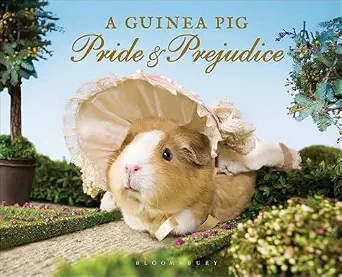
A Guinea Pig Pride and Prejudice by Alex Goodwin
It is a truth universally acknowledged, that a single guinea pig in possession of a good fortune must be in want of a wife.
It is a truth personally acknowledged by Mrs. Bennet that all five of her furry daughters—Jane, Elizabeth, Mary, Kitty, and Lydia—are in need of husbands.
To her mother’s grave disappointment, Elizabeth Bennet is headstrong and won’t take just anyone, especially not the haughty Mr. Darcy. Elizabeth blames the arrogant gentleman for steering Mr. Bingley, one of the rare men in possession of a good fortune, away from her older sister Jane. But when boy-crazy Kitty and Lydia fall in with the wrong crowd, it is Darcy who saves the day—and the Bennet family honor—and wins Elizabeth’s tiny, rapidly beating rodent heart.
This delightful retelling of Pride and Prejudice is illustrated throughout with full color photos of the finest guinea pig actors working today. Costumers familiar with the elegant curves of the guinea pig form have tailored lush period looks. And of course, it is the love between guinea pigs that can best illustrate the depth of feeling between Jane Austen’s Elizabeth and Mr. Darcy.
Dear reader, due to this being a shortened version of the original text, as well as simplified for children, this book hits only the main highlights of Pride and Prejudice, but it is still a fun and light read, no matter your age! The miniature settings and clothing give this book an almost magical air. It reminded me a lot of the Look Alikes Jr. books from the late 90’s.
The last Pride and Prejudice adaptation I’ll be talking about today is my most favorite, and one I am still currently reading.
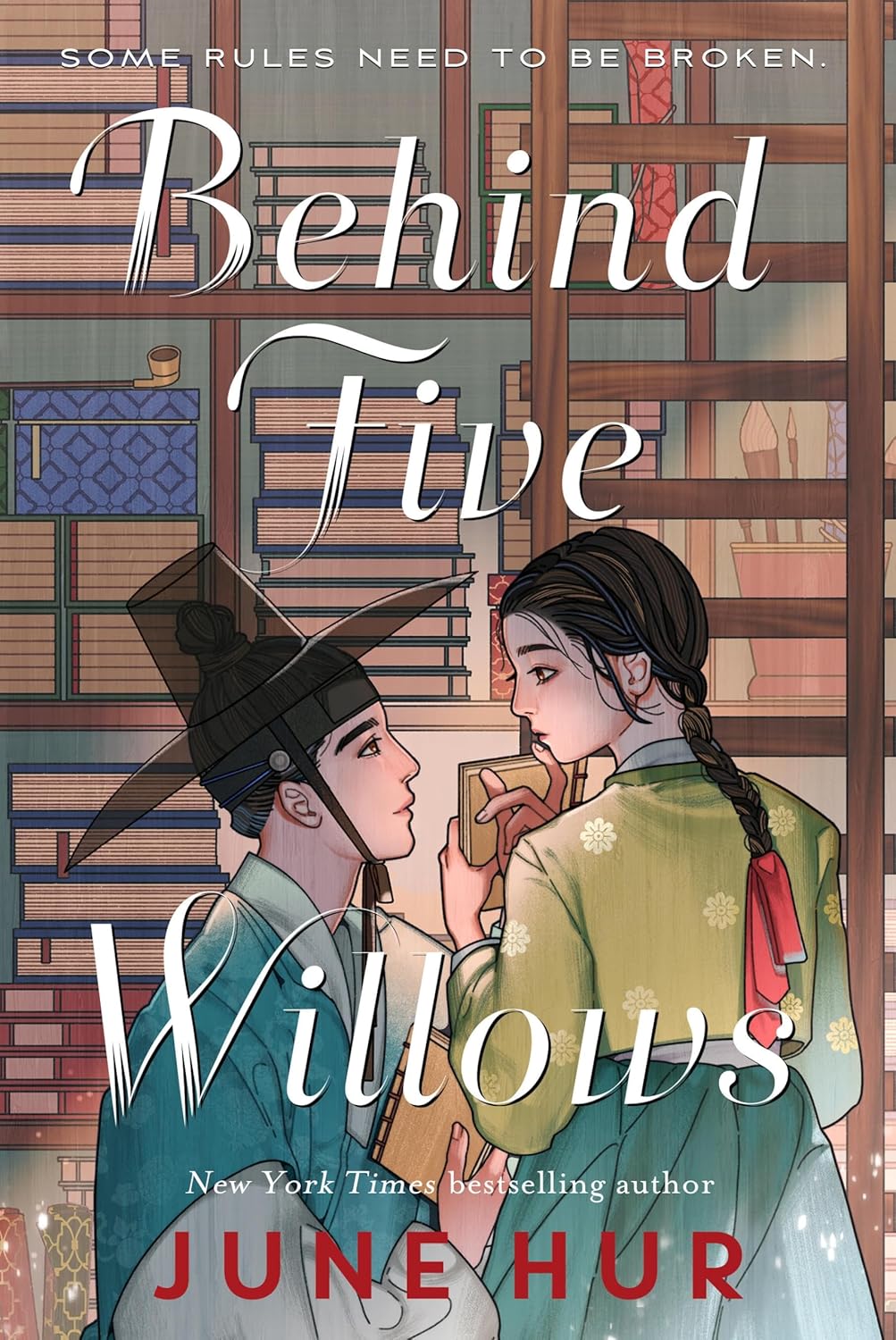
Behind Five Willows by June Hur
From the New York Times-bestselling author of A Crane Among Wolves comes a warm and romantic homage to Jane Austen’s Pride and Prejudice set in historical Korea, about a reader and a writer who secretly fight against government book banning and find themselves irresistibly drawn together.
As the dutiful second-eldest daughter of a poor family, society would have Haewon believe that her only hope of a decent life is to marry well. But during a time of rampant government censorship and book banning, she instead works as an illegal book transcriber to make a little extra money. It’s dangerous work, but she loves it—especially when she gets to transcribe the work of her favorite author, known as Black Lotus.
When her older sister becomes smitten with a wealthy young gentleman, Haewon is roped into chaperoning them during their courtship. Which wouldn’t be so terrible… if it weren’t for the young man’s uptight and annoying best friend who also accompanies them.
As the only son of a noble, Seojun has a lot expected of him. Wealth. Status. Respectability. Certainly not frivolous and often illicit activities such as reading fiction. But Seojun loves to do something even more scandalous: writing. He’s kept his work secret from his father and friends, but with each passing day, the pressure of being his father’s son and the dispiriting actions of the government make Seojun question the purpose of it all. The only thing keeping him going are the encouraging letters he receives from his transcriber, known only as Magpie.
When his best friend falls hard for a girl of lower social status, Seojun finds himself forced to act as chaperone to the infatuated couple—along with the girl’s younger sister, who is as irritating as she is judgmental. But as Haewon and Seojun spend more time together, they begin to suspect they may have judged each other too quickly…
Dear reader, it was thanks again to Instagram that I first heard about this retelling of Pride and Prejudice set in 1700’s South Korea. Hur does a fantastic job bringing the historical setting to life, and most importantly she shows you, not tells you, so you’re able to picture it for yourself! Hur’s historical details of the time are so rich and layered that this book at times read like non-fiction rather than fiction. And don’t let the young adult designation scare you off. While I admit the book does at times feel simplified for a younger audience, it doesn’t shy away from hard topics, and feels just as complex as if it had been written for adults.
During the late 18th century, the ban on foreign and Chinese books was heavily driven by Confucian ideals, culminating in King Jeongjo. An edict was put out to eradicate depraved literary styles, such as fiction, and more specifically romance. When the people realized one of their main sources of escapism was being taken away, an underground culture of transcribing and illegally circulating these banned novels was born.
Both in Jane Austen’s time, as well as during the time period of Hur’s book, a woman’s reputation was a most tenuous thing, wasn’t it? One misstep by a female member and your entire family would be thrown into ruin, with not one member of society looking back. A woman’s greatest achievement of the time would be to marry and produce a son for the family lineage. Men too, especially of noble birth, were expected to enter into marriages arranged purely from political standpoints.
The main female protagonist, Haewon, meets Seojun at the bookshop Five Willows, where Haewon brings her illegally transcribed books in exchange for her sister Jade’s reading of the many other banned books on its shelves. As in the original text, the two of them clash almost instantly, with Haewon assuming Seojun looks down on her family of lower birth and her unorthodox parents, while Seojun suffers from being too direct about such matters. At the time – again as in Jane Austen’s time – to marry outside of one’s social class was one of the greatest taboos.
Reading this book had made me want to read more into the history of South Korea. I believe it is the mark of a good book when it spurs you into other topics and into further reading, don’t you think? After all, what is reading but a constant learning of new things, a constant searching for new avenues, new adventures, new experiences that feed into one another? Thus a lifelong reader is born, are they not?

