Winter has finally arrived for us here in Wisconsin. I can’t say that I have been loving the biting winds on my walk to work. But it’s perfect weather to curl up with a book and get some reading done. I’ve rounded up the top fiction and nonfiction books from our holds list. This month we have The Women by Kristin Hannah and Oath and Honor by Liz Cheney blazing up our lists here at Mead. But don’t despair! There are a couple other books you can check out while you wait for those two books. For all of the books in this week’s post, I’ve included the book’s description from our catalog. Stay warm, everyone!
“When twenty-year-old nursing student Frances “Frankie” McGrath hears these unexpected words, it is a revelation. Raised on idyllic Coronado Island and sheltered by her conservative parents, she has always prided herself on doing the right thing, being a good girl. But in 1965 the world is changing, and she suddenly imagines a different choice for her life. When her brother ships out to serve in Vietnam, she impulsively joins the Army Nurse Corps and follows his path. As green and inexperienced as the men sent to Vietnam to fight, Frankie is overwhelmed by the chaos and destruction of war, as well as the unexpected trauma of coming home to a changed and politically divided America.”
The popularity of Mead’s e-book and audiobook services exploded over the last few years. I believe this was catalyzed by COVID, and our deep and consuming need to stay entertained or occupied at the end of the world. Now, even when things have returned to, uh, “normal” in the broad sense, usage of Libby and Hoopla remains at a fairly intense level. Library resources are community resources, and as a user myself, I try to cultivate best practices to be a good member of this large and active community that never actually comes face-to-face. Below, I explore a few simple ways to use Libby and Hoopla that make sense to the individual as well as the community at large.
LENDING PERIODS
Libby users have control over how long they can keep checked out material. Click on “settings” and choose from 7, 14, or 21 days as the default lending period. I listened to almost 140 audiobooks in 2023, so I tend to go through my checkouts pretty rapidly. I have my loan period set to 21 days regardless, because anxiety, even though I rarely have an audiobook checked out to me for more than a week. Shorter borrowing periods might be appropriate for those who have trouble remembering to return their e- and audiobooks once finished. If the book in question has limited copies and a lengthy waitlist, those down the list will be grateful for this expediency. Don’t get me wrong. We are each entitled to the complete checkout period we have selected. Some of us do NOT listen to 140 audiobooks a year, and may only get to read snippets during some fleeting moment of downtime.
WAIT TIME
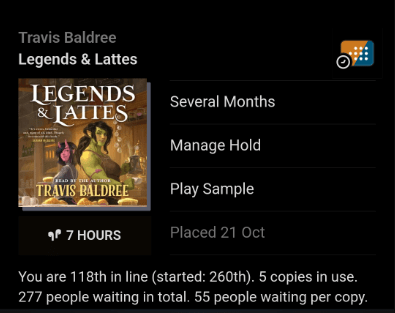
Library services are a great thing because they are democratic in that anyone with an account has the same opportunity to access material as any other account holder. The Monarch Libby interface gives users access to over 125,000 individual pieces of media, but we generally tend to gravitate toward the bright, new, and shiny things. Publisher restrictions and massive popularity can often mean a bottleneck situation on the user-end. For example, I am really looking forward to listening to Travis Baldree’s runaway gentle fantasy-romance hit Legends & Lattes. There are five copies in the system, and there are currently 277 people in total waiting in line to borrow. I am currently number 117 in line and placed this book on hold toward the end of October. I’m also waiting on Sarah Pearse’s The Retreat which has only 2 copies system-wide. What do I do in the meantime?
Use Libby’s wishlist feature
Maintain a wishlist of titles you’d like to eventually read
Limit your wishlist to “Available Now”
Choose from the list and voila, you are now reading or listening to a great book
Check Hoopla. Sometimes, but not always, Hoopa will carry some overlapping titles with Libby. For example, I had my Harry Potter year in 2019 and the wait for some of the series was a bit lengthy, even with dozens of copies in the system. These days, the series is available on Hoopla, so no wait time (in theory, see below).
HOOPLA
Before the pandemic I could check stuff out from Hoopla any time of day or night. I could use my ten credits with abandon. It was the life. As this service began to pick up steam, users may have noticed that it became necessary to use one’s credits as early in the day as possible. Hoopla has a system-wide collective borrowing limit. Once this limit is hit, users have to wait until the next calendar day to try and borrow material. It’s kind of a good problem to have, because we want our library services to be popular and sought after. The rub lies within how frustrating it can be to miss the opportunity to check out. Not all of us are night owls who will wait til midnight or after to try and do some Hoopla borrowing, or remember to try it out first thing in the morning.
What can the individual user do to help make Hoopla easier for everyone? Not a dang thing. That is a Mead problem, and has been addressed by Mead. The solution we arrived at in 2024 will hopefully resolve these frustrations. Firstly, more funds were applied to Hoopla to expand the daily collective borrowing limit. Secondly, we have reduced the total amount of monthly credits from 10 to 6. STAY CALM this is a great compromise when one realizes certain library systems (cough, cough, Milwaukee) allow their patrons a mere 4 credits per month or fewer.
One final approach I will mention is to use Mead’s Your Next Five Books service. Use the “Additional Information” field to leave a note that says you want Libby books that are available now. We will tailor your recommendations to this metric and hopefully help you get reading or listening to some hidden gems in Libby you might not have considered. I hope this advice is helpful, and happy reading.
As the new year quickly approaches, you’re probably looking forward to all of the exciting things you’ve planned to ring in the new year. That could be traveling, eating good food, seeing friends, or even just sitting from the comfort of your own home while watching the ball drop. Whatever it may be, you’re probably also thinking of a new year’s resolution for once the celebrating is over.
And if you picked running as your goal for the new year, you may feel a mixture of excitement and anxiety. Starting can seem like a daunting task, after all — as someone who got into running a little over a year ago, I can relate. There’s a lot of questions that come up in the beginning. How far should I run? What should I wear? And how do I stop chafing so much? (All questions I’ve asked myself)
Since I’ve started, I’ve learned a lot about the joys of running and come across many books on the subject. And today, I’d like to share some of my favorites with you. They cover a range of topics like how to get started, why to get started, and how to keep going, all while offering some helpful tips that runners of all levels can appreciate:
Ten years ago, Martinus Evans got some stern advice from his doctor: “Lose weight or die.” First defensive, but then defiant, Evans vowed that day to run a marathon, though his doctor thought he was crazy. Since then, Evans has run eight marathons and hundreds of other distances in his 300-something body, created his own devoted running community, and has been featured on the cover of Runner’s World.
This book is a blueprint for those who may not fit the image of a “traditional” runner – that is, someone who is larger in size, less athletic, out of shape, or dealing with any kind of health issue that slows them down – to feel empowered to lace up their shoes and embrace the body they have right now.
Looking to have some fun during the cold winter? Mead Library has you covered! Your library card is truly the gift that keeps giving, for free, all year.
Listen to Us!
Mead Library has a radio station that you can livestream from anytime! Click here to listen!
We have a great selection of passes to Wisconsin destinations that can be checked out, all year long!
The Hamilton Wood Type & Printing Museum is our newest addition to the lineup! Read more about them here!
All passes are checked out at the 1st floor’s circulation desk on a first come-first served basis.
Learn more about the passes, see the full list of offerings, and more here.
Makerspace
Use the Imaginarium, Mead’s Makerspace! Check out an open studio or learn more about using the space here. Some of the technology available includes:
3D Printers
Adobe Editing Suite
Sewing Machines
AccuCut Dies
Digital Conversion Station
Games
Plan a game night! The library has a bunch of options for you including:
Video Games: for XBOX, PS4/PS5, and Switch consoles!
D&D campaign books: located on 2nd floor!
Murder Mystery games: Located on the 1st floor Experience Collection display, you can get your friends together and solve a murder! Look out, Nancy Drew.
Geek Boxes: Geek Boxes are boxes that have a collection of items related to a popular theme, such as a cult movie. The boxes will have a variety of fun items with possibilities that include themed games, soundtracks, books, and more! Check out our collection of Geek Boxes on the 1st floor or in our online catalog here.
Programs
There’s always programs for every age and interest at the library! Check our calendar for more details or pick up a seasonal program guide from any of our floors. Some upcoming January highlights include:
Sewing classes
Genealogy Club
Learn to 3D Print
Ukulele Lessons
Crafts
Storytimes
Book Clubs
Baking tools
Located on the second floor, you can find a large variety of baking tools that can help you create yummy masterpieces. Conveniently, our large cookbook collection is nearby!
No matter what your interests, Mead Public Library has all kinds of things to help warm up your winter!
Kanopy. We use it. We love it. Couldn’t be better. Or could it? For those who aren’t familiar, this is a streaming service provided for Mead Library cardholders with funding from the City of Sheboygan and Mead Library. Kanopy is a source for hundreds if not thousands of films and television shows, including indie, mainstream, domestic, and foreign material in every genre imaginable. For those who are familiar, but haven’t visited Kanopy lately, there has been a fundamental change to how we use this service.
Originally, Kanopy users received 10 credits per month, which meant each cardholder had the opportunity to view 10 programs. One credit per program, whether it was a 4 hour war epic or a 20 minutes television program, which meant I personally never used my credits to watch TV shows. The updated version of Kanopy provides users with 30 “tickets” per month. Users will notice each program lists a ticket cost to view, as well as how long the user has to watch the program once it’s selected. Below, I spend my way through a month’s worth of tickets to demonstrate how much excellent streaming can be done with this new system. Kanopy Kids does not require credits to view. Let me repeat that: KANOPY KIDS DOES NOT REQUIRE CREDITS TO VIEW. How much Franklin & Friends can you watch? Now is your chance to find out. To learn more about how this new ticket system works, take a look at the Kanopy info page by clicking HERE.
Program Title: After Hours (1985) directed by Martin Scorsese Tickets: 4 Watch within: 48 hours It’s the start of the month. I am almost choosing at random. I have so many credits to expend.
Program: Lunch Time Heroes (2015) directed by Seyi Babatope Tickets: 2 Watch within: 72 hours Martin Scorsese rubbed me the wrong way, so I need something tonally different in every way. Luckily, Kanopy comes with the variety. This Nollywood comedy should do the trick.
Program: Barry Lyndon (1975) directed by Stanley Kubrik Tickets: 4 Watch within: 48 hours It’s a new day, maybe it’s the weekend. My energy feels low. I want to zone out at something beautiful. Thanks to Barry Lyndon, (RIP Ryan O’Neil) each frame looks like a Rococo painting. I make a sandwich and stare open-mouthed at the screen for more than three hours.
Program: Scott & Bailey series one (2011) six episodes Tickets: 4 Watch within: 7 days I have all week to watch six episodes of this English detective show. I watch one episode after dinner of the work week each night and then two on Friday. This is totally engrossing and I spend some time each day looking forward to the next episode.
Program: The Good, the Bad, the Weird (2008) directed by Jee-Woo Kim Tickets: 2 Watch within: 48 hours It’s the weekend again and I want to be entertained. I want big, incomprehensible set pieces and chaos. This 2008 picture has been determined to be bonkers. I have a marvelous time.
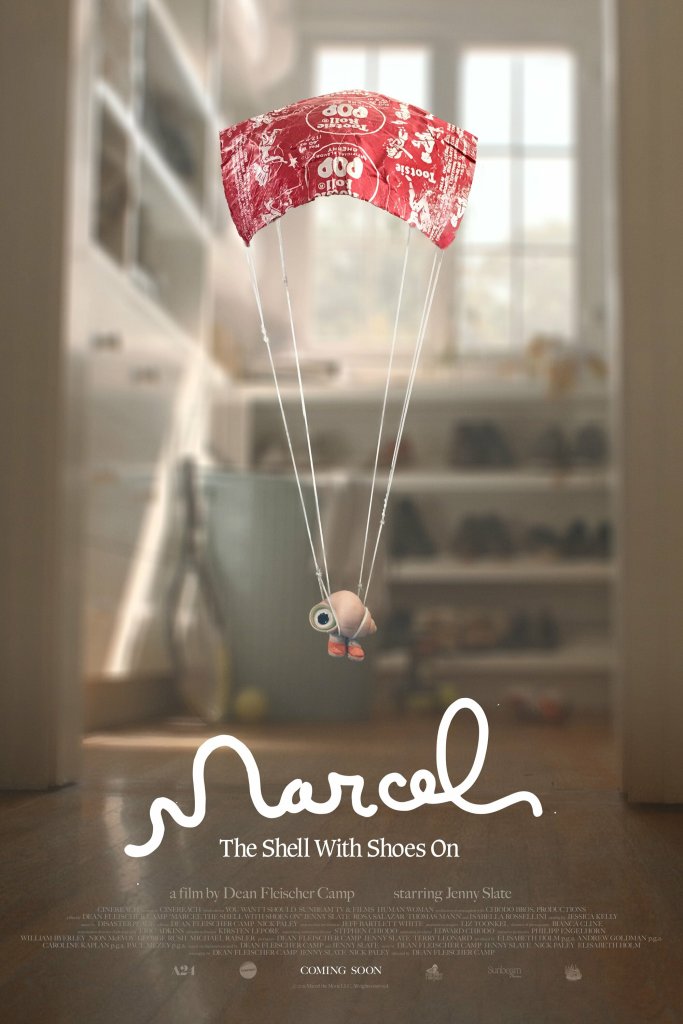
Program: Marcel the Shell with Shoes On (2021) directed by Dean Fleischer-Camp Tickets: 2 Watch within: 72 hours While I still want to be entertained, I need something more on the gentle side than the non-stop freneticism of a Korean western. Marcel is wholesome and soothing. It’s an A24 production, but not horrifying. I watch before bed and sleep beautifully.
Program: The Prisoner (1967) SEVENTEEN episodes Tickets: 5 Watch within: 21 days It’s been a minute since I’ve seen an episode of this psychedelic time capsule. Nostalgia for a show I watched with my dad thirty years ago is strong, so I check it out. I have three weeks to watch seventeen episodes. I get half-way through before I lose interest. My enjoyment of the costuming and set design is not enough to distract me from the, uh, plot.
Program: Everything, Everywhere, All at Once (2022) directed by Daniels Scheinert and Kwan Tickets: 2 Watch within: 72 hours I’ve already seen this masterpiece, but I am in the mood for a re-watch, and I can’t find it on the streaming services I pay for. It’s kinda long, so I watch it over two days knowing I have a third day if needed.
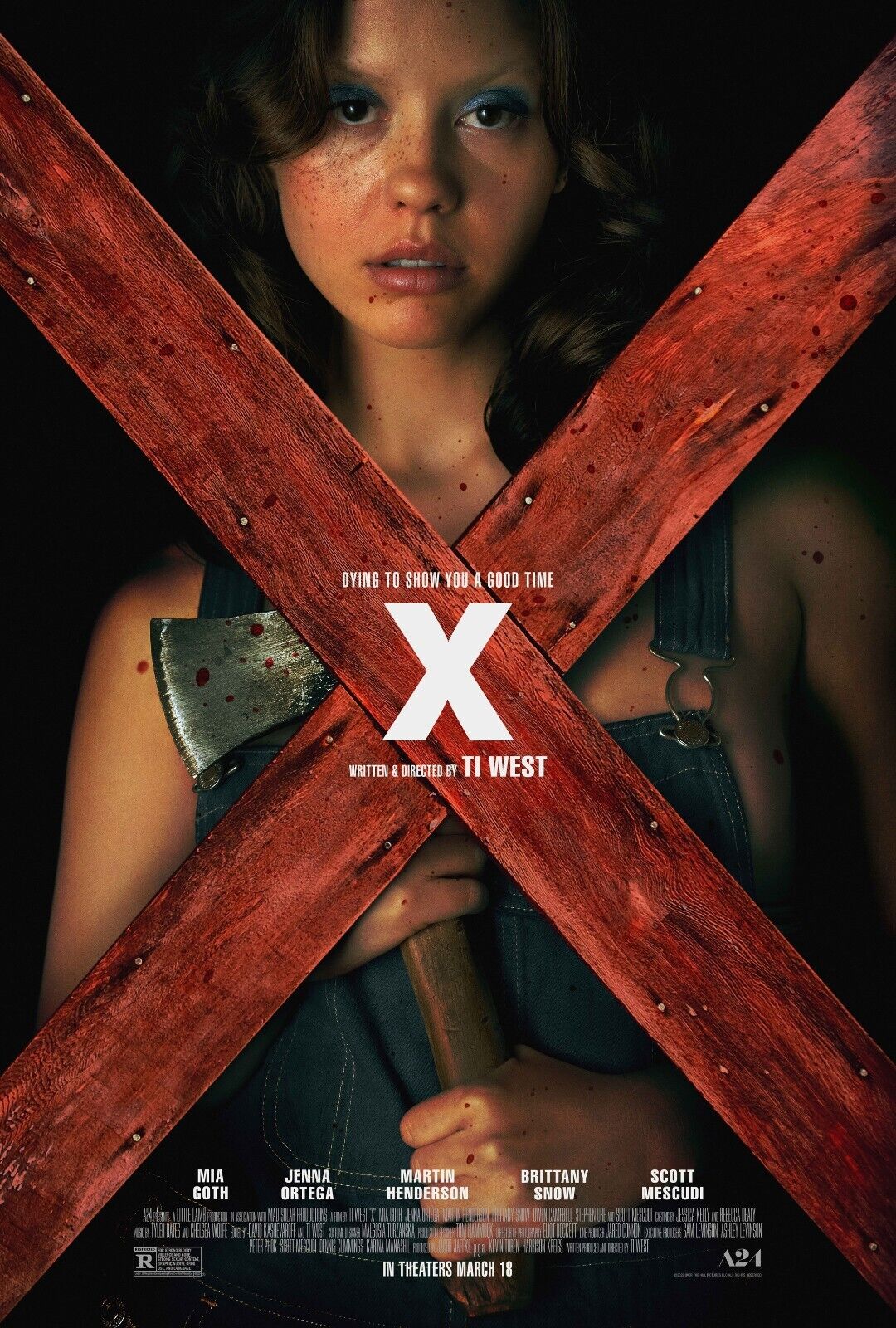
Program: X (2022) directed by Ti West Tickets: 2 Watch within: 72 hours It’s almost Christmas and I have a friend over for a movie marathon. She picks this. It’s great, but not terribly Christmassy. FYI: this is an archetypal A24 production and should be approached with caution. Try not to look it in the eyes, you know?
Program Title: Black Christmas (1974) directed by Bob Clark Tickets: 2 Watch within: 72 hours SOMEone has to pick out an appropriate seasonal film to watch in the Christmas month. This is my favorite slasher film (besides The Burning) and it’s so super festive!!!!!!
I still had one ticket to burn at the end of all this, and I was unable to find any programs available for less than two tickets. But dang! Look at all that good stuff on the list. It still evened out to ten titles in all, but with the inclusion of two tv series, I found the ticket system to be pretty fair and consistent. Households with more than one active Mead Library card can join forces to enjoy one another’s tickets together. Or horde your own and watch in the dark basement on a cracked phone screen like the goblin you know you are.
What to do in case of no access to WiFi or other internet connectivity? Welp, Mead Library is in possession of many hundreds of DVD and BluRay discs, not to mention the wider Monarch consortium. But Molly, you ask, what if I do not own a DVD player? Please get a load of our circulating external DVD player. Take a look at the catalog listing HERE. BUT MOLLY, you implore, what if I do not have access to a television? Let me tell you about our private study rooms on the second floor. Two of them contain desktop computers for public use. The external DVD player can be hooked up to a computer very easily, and we can have you watching the DVD of your choice in mere moments. People can also use their Kanopy accounts on a library computer, as well. Call 920-459-3400 option 4 to learn more about our private study rooms.
We’ve had access to Kanopy via Mead for about five years now. It’s so appealing I know of several people who signed up for a library card after many years of absence just to have access to Kanopy. It’s an awesome service and I’m glad it brought people back into the fold. Keep in mind this is only one of a suite of resources one can use anywhere on earth that has internet access.
Please don’t hesitate to reach out in order to learn more about how to access and use Kanopy, or any of our other services. Not sure what to watch? Consider utilizing our excellent Your Next Five Movies service which you can find by clicking HERE.
NOTE: Apologies! It was pointed out that the first version of this post had a book in it, The Stakes by Ben Sanders, where the only copy in the library system had been withdrawn – it wasn’t actually available! It’s been replaced with a new readalike below.
On the fiction side, we’ve got a new Nick Petrie book being requested like mad. It’s the eighth book in his Peter Ash series, so people who have gotten invested in them are clearly eagerly awaiting this new release. And there’s nothing to boost the popularity of a non-fiction book like being made into a movie, so it’s not surprising that Killers of the Flower Moon is seeing a surge in popularity (plus, my mom says it’s an amazing book!).
Lewis has helped Peter Ash out of more trouble than Peter cares to remember. So he doesn’t hesitate when Lewis asks a favor in return. Lewis has left his criminal past behind, but a former associate may be in trouble, and he and Peter must drive into the teeth of a blizzard to find him. When they discover blood in the snow and a smoldering cabin, both men know things are bad. Then they learn that someone has stolen notebooks full of incriminating secrets about Lewis’s long-ago crimes, and realize the situation is much worse than they’d thought.
To save Lewis’s wife, Dinah, and her two boys, Lewis and Peter must find the notebooks. With Peter’s longtime girlfriend, June Cassidy, they begin the search—facing ruthless and violent foes at each turn, including one powerful person who will stop at nothing for revenge. Will Peter and Lewis be able to keep that dark past buried? Or will they need to step into the darkness to save the people they love most?
As a child, one of the highlights of any visit to my grandparents’ house was seeing the Sheboygan Breakwater Lighthouse near Deland Park. On a stormy day we would look at the lighthouse from a safe distance, but when the lake was calm and the weather was nice, my grandparents would walk all the way down the pier with me to see the red lighthouse tower up close. Though no one lives in Sheboygan’s lighthouse, I would still imagine what it might be like to make a lighthouse your home!
If you or your family are similarly interested in lighthouses, here are some children’s picture books which will light up winter’s darkest nights!
The illustrations are the star in this lighthouse book, from the eye-catching cover to depictions of whales, icebergs, and the Northern Lights. My favorite illustration, however, is a lighthouse cross-section that will fuel young readers’ imaginations. This colorful book is a delight to look at for all ages.
In addition to the fantastic illustrations, Blackall also did her research, and if your curiosity isn’t sated by the main text, check out the book’s endnotes for more historical information!
Two months in a row with a non-fiction book topping the most-requested items list – it certainly seems to be the season of the memoir this fall! And this time, it’s Britney Spears’ new book, The Woman in Me, that everyone wants a copy of. And on the fiction side, we have quite a few familiar names as the big authors release new books in time for holiday gift-giving. At the top of that list is Kristin Hannah’s The Women. Get on the waitlists ASAP, and while you wait, check out the similar titles we’ve picked out below!
When twenty-year-old nursing student Frances “Frankie” McGrath hears these unexpected words, it is a revelation. Raised on idyllic Coronado Island and sheltered by her conservative parents, she has always prided herself on doing the right thing, being a good girl. But in 1965 the world is changing, and she suddenly imagines a different choice for her life. When her brother ships out to serve in Vietnam, she impulsively joins the Army Nurse Corps and follows his path.
As green and inexperienced as the men sent to Vietnam to fight, Frankie is overwhelmed by the chaos and destruction of war, as well as the unexpected trauma of coming home to a changed and politically divided America.
This month’s titles include the second entry in Travis Baldree’s groundbreaking cozy fantasy series, a multi-generational family story, and a pointed look at social mobility in America from the author of Maid.
In this worthy prequel to Legends & Lattes, a young Viv is laid up in the quiet town of Murk after her enthusiastic inexperience leads to a serious injury. She gradually assembles a group of friends including a swear-happy bookshop owner, a mercenary turned baker, and an irrepressible Gallina, eager to join Rackham’s Raiders. Murk doesn’t stay quiet for long with Viv around, and there’s plenty of coziness in the bookshop, eating delicious baked goods, and flirting with a new friend.
—Lauren Abner, KY Dept for Libraries & Archives, KY NoveList read-alike: Under the Whispering Door by TJ Klune
Dear reader, today I have something a little different in store for you. Over the last year I have read several short stories by Japanese authors and felt moved to collectively talk about all of them.
Most of the short stories in today’s blog post have the characters coming together around a certain theme or object. For instance in What You are Looking For is in the Library, the characters all encounter a particular librarian, and in Before the Coffee Gets Cold, the characters all start their individual journeys in a certain coffee shop.
Another theme that all the short stories share is how each character encounters a seemingly innocent situation or thing, and that blossoms into an altered life, a change in character, a new outlook, etc. For example, in Sweet Bean Paste, the main character, after learning a new homemade recipe for red bean paste from an elderly lady instead of the pre-made store bought variety he was using, goes down a path of self-discovery , gains a new friend, and learns the dark history of a nearby dwelling. Unfortunately, Sweet Bean Paste is not in the Monarch system, but can be found in Wiscat, as well as Hoopla, one of Mead Public Library’s apps for online reading. I will also mention several other short stories that are available via Monarch, so have no fear, dear reader!
Revitalized lives is a third main theme in these short stories. Characters who, at the start of the stories, were at the end of their rope, the outcasts of society, viewed as failures, but by story’s end are living with purpose and even fulfilling a forgotten dream. This is the case in Lonely Castle in the Mirror and Days at the Morisaki Bookshop.
Hidden in Jimbocho, Tokyo, is a booklover’s paradise. On a quiet corner in an old wooden building lies a shop filled with hundreds of second-hand books.
Twenty-five-year-old Takako has never liked reading, although the Morisaki bookshop has been in her family for three generations. It is the pride and joy of her uncle Satoru, who has devoted his life to the bookshop since his wife Momoko left him five years earlier.
When Takako’s boyfriend reveals he’s marrying someone else, she reluctantly accepts her eccentric uncle’s offer to live rent-free in the tiny room above the shop. Hoping to nurse her broken heart in peace, Takako is surprised to encounter new worlds within the stacks of books lining the Morisaki bookshop.
As summer fades to autumn, Satoru and Takako discover they have more in common than they first thought. The Morisaki bookshop has something to teach them both about life, love, and the healing power of books.