
Greetings readers and welcome to November. As the weather turns cooler, this month’s blog is a special one for me. I have been extremely fortunate to be able to live on the shores of not just one of our Great Lakes, but two of them. As much as I love Lake Michigan, there is always a special place for me near Lake Superior. I fondly reflect on the times I spent growing up in Superior. Seeing all the big, massive ships coming to dock in Superior and Duluth, is a memory that still brings a smile to my face.
My family has had deep roots and ties to Superior and the surrounding area for generations. I have been told over the years that my great-great grandfather was a member of the crew that built the Wisconsin Point Lighthouse in Superior. My great aunt also worked on the massive thousand-footer ship, the Mesabi Miner for a great number of years as a second cook. I have always had a strong interest in the ships and the industry that helped shape Superior.
I remember the first “lake” I visited after relocating to southern Wisconsin with my family. I remember looking at it and thinking, “this is a lake? But I can see the other side.” I honestly think I could have very easily thrown a rock, and it would have reached the other side. My ten-year-old self was extremely perplexed that it was called a lake, considering the lake that I had just moved away from. I also remember a time when I told my grandpa that I wanted to go swimming visiting him in Ashland. My mind was determined that swimming was happening that day no matter what! Well, it was the fastest “swim” I ever took. I remember how he laughed after he told me, “Go ahead and jump in”, and I did. Even now I smile about it, because just as I jumped in, I jumped right back out in one uninterrupted motion. My own children have also tried swimming in Lake Superior, with very similar reactions. Although some of the bays warm up to comfortable swimming temperatures, much of the lake is always cold and never warms up.
I remember going to my new school and how shocked I was not many of my classmates knew of the Edmund Fitzgerald. Growing up in Superior, I knew all the lines of Gorgon Lightfoot’s song by heart in kindergarten. I’m pretty sure it might have been the school song at, at least, one of the elementary schools I attended there.
Like I had mentioned earlier about the big, massive ships, it’s difficult to fathom the forces needed to take one of them down, and those forces coming from a lake. Last year it was the 50th anniversary of the sinking of the Edmund Fitzgerald. I had heard about a new book being released and was so excited to get my hands on it, and I cannot put into words how happy I am to share and recommend it to all of you.
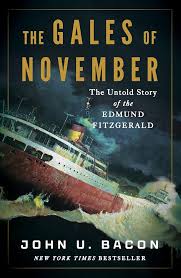
The Gales of November by John U. Bacon
There are many books titled the untold story, but this one truly is. John U. Bacon didn’t solely focus on one side of the mystery surrounding the sinking, and that is what made this book so special. John Bacon did extensive research and conducted hundreds of hours of interviews with 14 of the 29 families affected the most by the sinking. Many of whom, this being the first time they have publicly spoken about their family member who was lost. He also interviewed previous crew members not only of the Fitzgerald, but other ships, as well as other historians and archivists. He also interviewed members Gordon Lightfoot’s band. The author truly humanized the crew. I feel like when disasters like this happen, so often, the human side of it gets lost. The legend takes off and we forget that these were real people. By the end of this book, I felt like I knew the crew members personally even though the ship sank a decade before I was born.
The Fitz wasn’t just the pride of one location in the Midwest, but the pride of the Midwest and Great Lake states as a whole. Each state along the great lakes has at least one tie to the ship. Whether it be from the states bordering the shores where crew members were from, to the name coming from the president of Northwestern Mutual Life Insurance just down the road from us in Milwaukee, where the headquarters office is still there today. The shipyard where the ship was welded together and launched in Michigan. Pennsylvania where the engine was built, New York where the broilers were built, and the Great Lakes Engineering Company that made different sections of the hull. It’s no wonder that the Fitz had the glamour it did. She was built to shine, and for 17 years she and her crew shined like no other.
I think it is too simple for those of us who have never experienced the full force of the Great Lakes to ask questions like, “Why didn’t the shipping industry just use trains, or a safer way of transporting?” Here is that answer: did you know that it would take on average anywhere from 290 – 418 rail cars to transport the same amount a single load carried by the Fitzgerald? The train would stretch 3 miles long. Could you imagine being stuck at a crossing waiting for that train to pass on your morning or afternoon commute?
I know from first hand experience just how fast the weather can change on Lake Superior. Many homes in Superior didn’t have air conditioning. You didn’t need it, just wait for the wind to switch. I also remember missing a year of trick or treating because it snowed 36 inches on Halloween. This is the reason that anytime I go to visit places near Lake Superior, I pack colder weather items in addition to warmer weather items.
This book contains historical information not only about the shipping industry but the entire region and tells how the raw goods from the Midwest like lumber, iron ore and taconite kept not only the region, but the country’s economy growing. It also touches on the superstitions surrounding maritime lore, things like how many times it took the bottle to break, difficulty in launching, and that someone died at the event. Recognizing those superstitions, it does make one question, was it cursed?
I also learned in this book that the ship wasn’t only used for shipping, but that it also was used at times as a cruise ship for VIP guests. Crew members reported that the food served on the Fitzgerald was the best for everyone onboard, not just the VIP guests. Also in the book is historical information about the storm itself, as well as information about all the theories that have been made about what took down the ship.
Now did this book give me a theory that I said, “That’s it, that is what caused the ship to sink!” No, it did not. Just as with any book or documentary I can’t necessarily say that any of my questions were answered, but I do feel after reading this book that I got more information about all of the circumstances that occurred. I think that the only thing that anyone can take away from this maritime disaster is that nature will always win, and Lake Superior will never give up her secrets.

