
Dear reader, although November has come and gone, the shipping season on the great lakes won’t end until the Soo Locks close at 11:59pm on January 15th 2026. And even once they do close we can still talk about ships because how else will us ship nerds survive the long barren winter?
But there’s more to wait for than the reopening of the Soo Locks on March 25th 2026. What’s that, you ask? The new book about the Edmund Fitzgerald, The Gales of November by John U. Bacon. This book was released just ahead of the 50th anniversary of the ship’s sinking. However, I can’t talk about it because I haven’t read it yet! The last time I checked I’m still number 32 in the holds queue for it. Isn’t there something exciting about checking your placement in the holds queue for a book you really want? It’s like Christmas day when you finally get the notification that it’s available for checkout!
So while you wait for your copy of The Gales of November to come in, I’ll spend our time together talking about other books either about the Fitzgerald sinking or other shipwrecks that have happened on the Great Lakes.

The Gales of November by John U. Bacon
For three decades following World War II, the Great Lakes overtook Europe as the epicenter of global economic strength. The region was the beating heart of the world economy, possessing all the power and prestige Silicon Valley does today. And no ship represented the apex of the American Century better than the 729-foot-long Edmund Fitzgerald—the biggest, best, and most profitable ship on the Lakes.
But on November 10, 1975, as the “storm of the century” threw 100 mile-per-hour winds and 50-foot waves on Lake Superior, the Mighty Fitz found itself at the worst possible place, at the worst possible time. When she sank, she took all 29 men onboard down with her, leaving the tragedy shrouded in mystery for a half century.
In The Gales of November, award-winning journalist John U. Bacon presents the definitive account of the disaster, drawing on more than 100 interviews with the families, friends, and former crewmates of those lost. Bacon explores the vital role Great Lakes shipping played in America’s economic boom, the uncommon lives the sailors led, the sinking’s most likely causes, and the heartbreaking aftermath for those left behind—”the wives, the sons, and the daughters,” as Gordon Lightfoot sang in his unforgettable ballad.
Focused on those directly affected by the tragedy, The Gales of November is both an emotional tribute to the lives lost and a propulsive, page-turning narrative history of America’s most-mourned maritime disaster.
Dear reader, one thing I love the most about nonfiction books is the fact that they not only give an in-depth account of the topic they’re covering, they also give you the backstory leading up to it, such as the political climate, social attitudes, etc. It’s especially fascinating to read about such things when you haven’t grown up in the time period the book is covering.
For instance, in a recent documentary I watched on the Edmund Fitzgerald it was mentioned how the Coast Guard was trying to cut costs by automating certain lighthouses. It was strongly advised not to automate the Whitefish Point lighthouse, which was a crucial point to warn sailors of dangerous shoals, but automated it was and on the night of the Fitzgerald’s sinking the infamous storm had knocked out power to the lighthouse, thus depriving the Fitzgerald’s crew of yet another point of navigation. In the same documentary it said while the Fitzgerald was at the ore dock in Superior, WI a crane operator had damaged the ship’s navigational equipment, so by the time they were out in open water and in the thick of the storm they were basically running blind. One speculation on the cause of the Fitzgerald’s sinking is, due to this lack of navigational equipment, they inadvertently steamed too close to the shoals of Caribou Island and damaged the hull of the ship unknowingly. Even 50 years later we still do not know what ultimately led to the Fitzgerald’s tragic sinking. Her final resting place in Canadian waters was in 2006 declared a gravesite due to the remains of all 29 crew members still being on board, so there are no longer dives down to the wreck to investigate it.
When she was built the Fitzgerald was the largest and fastest ship on the Great Lakes. In fact, when she was launched into the water for the first time she was the largest to have done so. In the same documentary it mentioned how her accommodations for visiting dignitaries and their families were appointed with the most up to date technology and luxuries of the time. She was the star of her fleet and consistently broke old records and created new ones for the most cargo hauled in a season. She was also the first ship to have a welded hull. This allowed her to be built in record time. Here lies another speculation on the cause of her sinking, with some saying it was this accelerated, welded design that led to a compromise in structural integrity.
This theme of being the largest ship on the Great Lakes also applies to another shipwreck, that of the Carl D. Bradley, which sank in Lake Michigan in 1958.
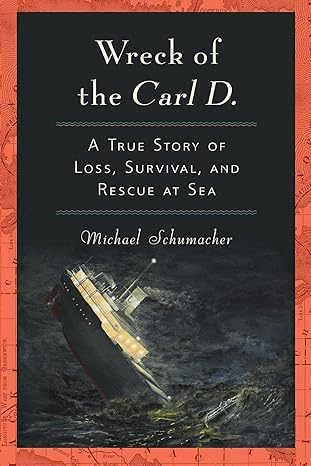
The Wreck of the Carl D. Bradley by Michael Schumacher
On the night of November 18, 1958, the Bradley, a 623-foot limestone carrier, was torn apart during one of the most violent storms in Lake Michigan history, sinking in less than five minutes. Only four members of the crew survived the wreck, two of whom died battling thirty-foot-high waves that night, while the other two barely survived the freezing cold water.
News of the Bradley shocked the residents of Rogers City, Michigan, a hard-scrabble town of 3,800 and home to most of the ship’s crew. Rogers City was dependent on the Bradley, and the ship’s loss nearly crippled the town.
In Wreck of the Carl D., Michael Schumacher reconstructs, in dramatic detail, the tragic accident, the perilous search and rescue mission, and the chilling aftermath for the small Michigan town that many of the victim’s families called home. Publishing on the 50th anniversary of the wreck, Schumacher’s dramatic follow up to Mighty Fitz is a wonderful addition to the literature of the Great Lakes and maritime history.
Dear reader, I read this book many moons ago and in looking it up just now for my blog post I realized this one too was written 50 years after the sinking of the Bradley, just as the book on the Fitzgerald was written 50 years after its sinking. How interesting.
Unlike the Fitzgerald, which was less than 20 years old when it sank, the Bradley was 31 years old and due for an inspection at end of her last voyage of the season. She was due to end her season earlier but her crew was called out for one final run. When she sank the Bradley was running light – without cargo – with only water in her ballast tanks. The ballast tanks run the length of a ship’s cargo hold and can be filled with water in the case of running light for stability’s sake.
Speaking of unhappy consequences, it was also the last run for the Fitzgerald’s captain, Ernest McSorely, he was due to the retire at the end of it.

Mighty Fitz by Michael Schumacher
The disappearance of the Edmund Fitzgerald remains one of the great unsolved mysteries in maritime history. Michael Schumacher relays in vivid detail the story of the Edmund Fitzgerald, its many productive years on the waters of the Great Lakes, its tragic demise, the search effort and investigation, as well as the speculation and the controversy that followed in the wake of the disaster.
Dear reader, as with other major disasters, in the wake of the Fitzgerald’s sinking, there were major changes implemented in the shipping industry, and there hasn’t been another sinking on the Great Lakes since.
During the Fitzgerald’s time, shipping companies, in an effort to increase the tonnage and profit of loads, raised what is called the freeboard. Freeboard is the amount of the ship that is visible out of the water when the ship is fully loaded. This raising of the freeboard allowed ships to be loaded to a deeper level, thus causing ships to ride lower in the water. Herein lies yet another speculation on the Fitzgerald’s sinking. Did the habitual overloading of her cargo holds permanently damage her hull in unseen ways, or did her decreased freeboard effect how she handled the waves that fateful day? As mentioned before, we may never know what ultimately caused her sinking. The United States Coast Guard – USCG – rescinded the 1973 Load Line Regulation amendment that permitted reduced freeboard loadings.
Also, the USCG began the annual pre-November inspection program where Coast Guard inspectors now board all U.S ships during the fall to inspect hatch and vent closures and lifesaving equipment.
Dear reader, as you wait for your copy of The Gales of November to come in, take a moment to read not only these books but many others on the Fitzgerald and other shipwrecks throughout history. There are some estimated 600 shipwrecks in the Great Lakes, many of which have books written on them, and many more that have never been found. As Gordon Lightfoot said in his famous song about the Fitzgerald, “the lake, it is said never gives up her dead, when the skies of November turn gloomy.”
 Mead Public Library Blog