
Dear reader, I did a revolutionary act these past weeks. You want to know what it is? Hold onto your seats! Wait for it! I…read a book on my own bookshelf! I simply selected one and started reading it. I know, I know, I can’t believe it either. So many library books sitting at home, and yet I go and do something like that. Unbelievable!
However, it was for a good cause, so I could have something to write about for my blog post. The first book I’ll be talking about I just finished last night. Evening shifts at work are good for something after all, who knew? This first book wasn’t exactly a light read, despite what the cover may portray, but it was still highly satisfying. What I love about reading books by foreign authors is the glimpse into the everyday lives of people that at once seem familiar, but in other ways teach you something new and surprising. As a person who has never travelled outside of the United States, I approach these books as my “travel guides”, so to speak.

The Second Chance Convenience Store by Kim Ho-Yeon
Dok-go lives in Seoul Station. He can’t remember his past, and the only thing he knows for certain is that he could really use a drink. When he finds a lost wallet filled with documents, his life is drastically changed.
Mrs. Yeom, a retired history teacher and current owner of her neighborhood’s corner store, is distraught over the loss of her purse, until she receives a mysterious call from the person who found it. To thank this down-on-his-luck stranger, she offers him a free meal from the convenience store. Seeing the joy the food brings him, Mrs. Yeom impulsively invites him to stop by for lunch every day.
In a twist of fate, Dok-go saves the store from a robber—a brave act that propels Mrs. Yeom to offers the bear-like man a job working the night shift, despite the objections of her wary employees. The store’s new employee quickly wins over the quirky denizens of the neighborhood, becoming a welcoming ear and source of advice for his coworkers and neighbors’ problems, and helping his new boss save the store from financial ruin. But just when things are looking up for Dok-go, Mrs. Yeom’s good-for-nothing son, eager to sell the store, hires a detective to dig into the mysterious man’s past and what he seems to be trying so hard to forget.
The Second Chance Convenience Store is a moving and joyful story of a woman fighting for her community and a man who has lost everything except the will to try again.
If you’ve read my other my other blogs highlighting various novels by foreign authors you will recognize what is coming next, that many of them have the characters drawn to or interacting with the same thing, person, experience, etc., and then showing how each character is changed because of that interaction. This may seem repetitive to some, and even boring, but believe me when I say it is anything but! I never tire of reading about each character’s transformation.
In the case of The Second Chance Convenience Store, all the characters interact with – you guessed it! – the convenience store, but more importantly, it’s recent nightshift hire, Dok-go. Mrs. Yeom doesn’t need the convenience store from a fiscal point of view, but she keeps it running to provide jobs for those who do. When Dok-go returns Mrs. Yeom’s wallet to her and she – out of gratitude – gives him a job, this creates a butterfly effect for several other characters Dok-go comes in contact with. These are all characters who in some form or another have hit rock bottom and feel they have nowhere to go. Through food, kindness, his halting speech, and corn silk tea, Dok-go gives them hope and a new perspective.
These characters have dark, depressive thoughts. They contemplate suicide, – as does Dok-go himself – they’ve been alienated from their families, from society, from themselves. The book goes into how each character got caught up in the rat race, sacrificing everything to make it big in life, to prove that they’re not a failure to their parents, spouses, or families, but in the end this didn’t satisfy them, they were lost. The glimpse into how Dok-go slowly lost his humanity as a homeless individual living at Seoul Station was eye-opening as well. There is one line in the book where, when Dok-go finds Mrs. Yeom’s wallet and sees the note that, if found, please call this number, he says that please is what made him feel human. Even after he gets the job at the convenience store, Dok-go continues to visit the homeless community at Seoul Station and show them kindness, offering corn silk tea in place of alcohol, and conversation in place of silence.
One thing I found lacking with this book was the lack of closure with Mrs. Yeom’s son. I won’t give it away, but basically he is spiraling ever downward from one money-sucking scam to another, and while the book mentions in the end what became of his latest scam, unlike other children who were reconciled to their parents and turn their lives around, we are left hanging as far as Mrs. Yeom’s son is concerned. Again, it’s highly possible I missed something! I’m not the most attentive reader, after all.
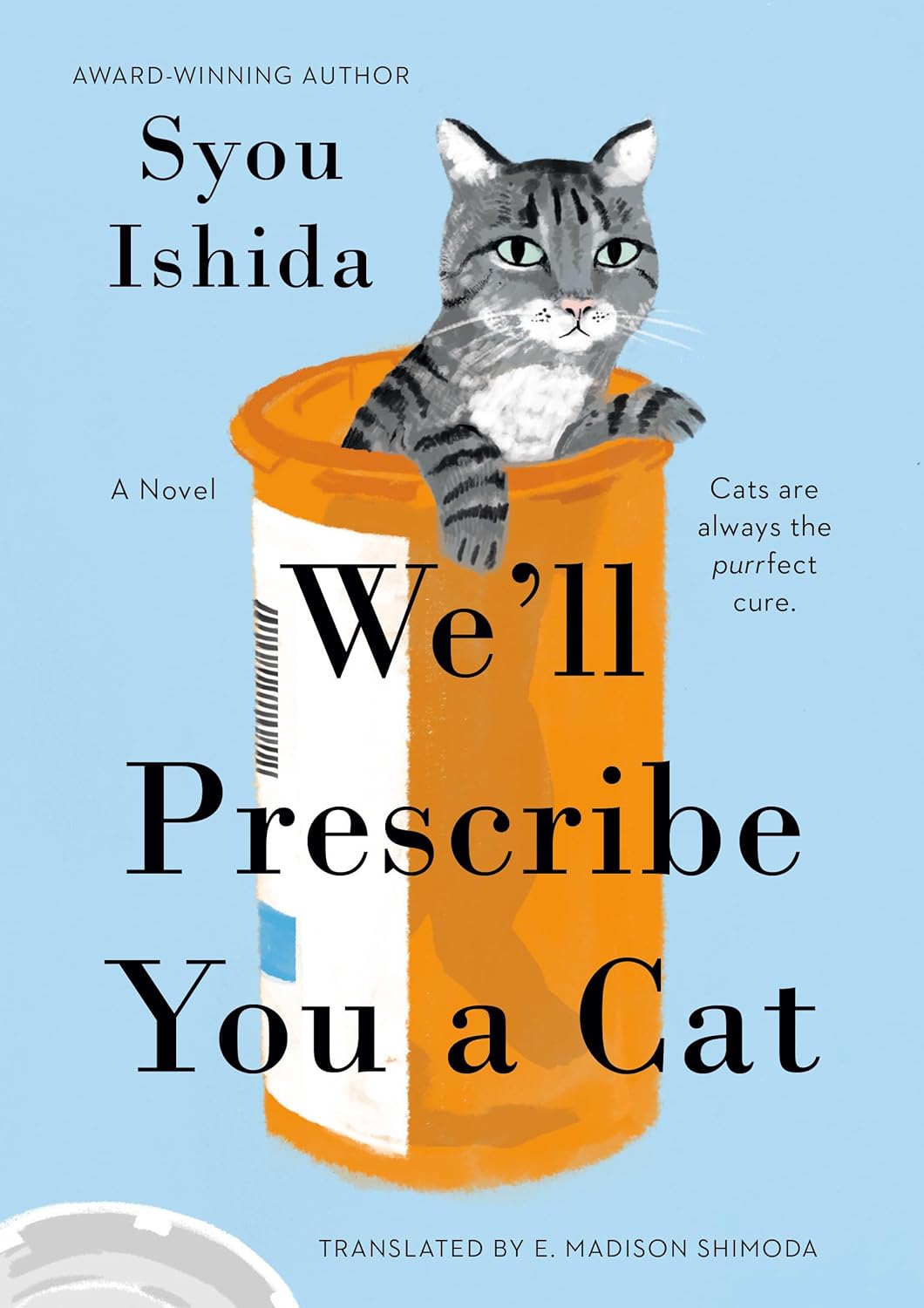
We’ll Prescribe You a Cat by Syou Ishida
Tucked away in an old building at the end of a narrow alley in Kyoto, the Kokoro Clinic for the Soul can only be found by people who are struggling in their lives and genuinely need help. The mysterious clinic offers a unique treatment to those who find their way there: it prescribes cats as medication. Patients are often puzzled by this unconventional prescription, but when they “take” their cat for the recommended duration, they witness profound transformations in their lives, guided by the playful, empathetic, occasionally challenging yet endearing cats.
Throughout the pages, the power of the human-animal bond is revealed as a disheartened businessman finds unexpected joy in physical labor, a young girl navigates the complexities of elementary school cliques, a middle-aged man struggles to stay relevant at work and home, a hardened bag designer seeks emotional balance, and a geisha finds herself unable to move on from the memory of her lost cat. As the clinic’s patients navigate their inner turmoil and seek resolution, their feline companions lead them toward healing, self-discovery, and newfound hope.
This is one of those books I wish I hadn’t bought the Kindle version of. Why? Because by the end of it everything came together and I felt an intense urge to be able to go back through the novel to underline stuff, because, as mentioned above, I’m not the most attentive reader and, like a completed puzzle missing a few pieces, there were definitely holes in my understanding! That aside, I still enjoyed this book.
Imagine going to the doctor and being prescribed a cat! Again, like many other Korean and Japanese books I’ve mentioned, the characters learn about this fabled cat dispensing doctor through word-of-mouth. It’s described as a mental health clinic and, understandably, each character is quite put off when they not only encounter the brusque receptionist, but also the flighty doctor who – I bet you didn’t see this coming – prescribes them a cat. He even tells them the dosage amount for the cat, and if you take too much it could have detrimental effects. Some cats have a stronger effect than others.
For various reasons each character visits the clinic because they are experiencing a mental health crisis. They have done something in their lives that they deem unforgivable, and they were unable to move past it. Enter the prescribed cat! Whether they’ve never had a cat before, or it’s been a long time, the cat’s needs upset the routine lives of each individual, forcing them to conform and change. Some feel overwhelmed, some doubt their ability to care for the cats, but by the end of their prescribed period, most don’t want to give the cats back. They’ve grown attached! Sometimes the first step to healing is getting out from inside your own head, focusing on something small and precious, and moving forward day by day while grasping it tightly.
Much in the vein of The Kamogawa Food Detectives the cat clinic is hard to find by all but those who are actually looking for it. Even the characters who went there initially and try to return can’t find the dingy alleyway where it’s located, or the door is there but it’s just an abandoned room. The clinic shows up in their time of need, and then disappears.
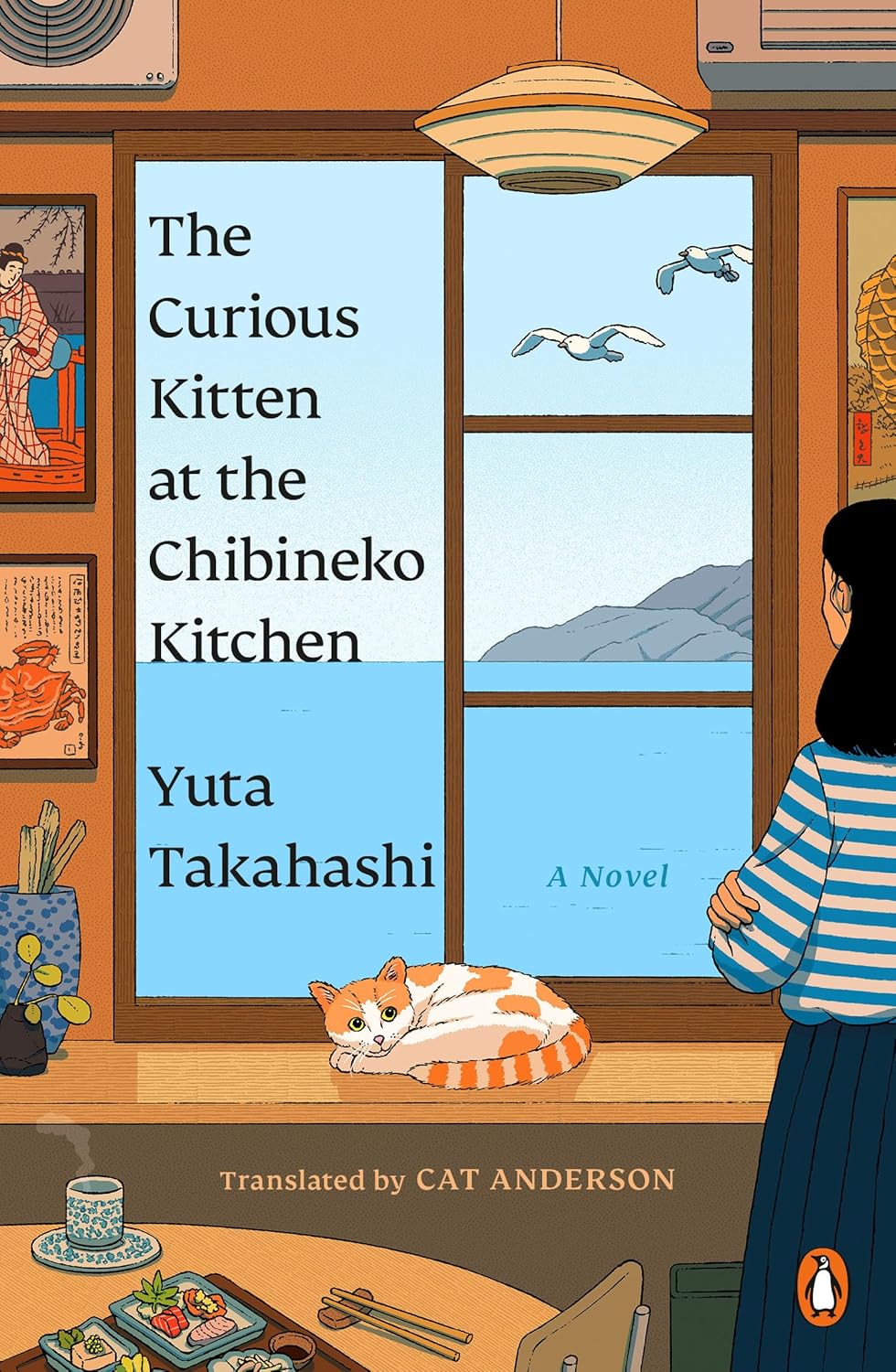
The Curious Kitten at the Chibineko Kitchen by Yuta Takahashi
In a remote seaside town outside of Tokyo, Kotoko makes her way along a seashell path, lured by whispers of an enigmatic restaurant whose kagezen, or traditional meals offered in remembrance of loved ones, promise a reunion with the departed. When a gust of wind lifts off her hat, she sees running after it a young man who looks like her recently deceased brother. But it’s not her brother; it’s Kai, the restaurant’s young chef, who returns her hat and brings her to the tiny establishment, where he introduces her to Chibi, the resident kitten, and serves her steaming bowls of simmered fish, rice, and miso soup—the exact meal her brother used to cook for her. As she takes her first delicious bite, the gulls outside fall silent, the air grows hazy, and Kotoko begins a magical journey of last chances and new beginnings.
Dear reader, one word of advice, don’t read this book if you’re hungry! Each chapter starts with a recipe, as well as other recipes being heavily described within each chapter. I’m not much of a fish person myself – chicken all the way! – but by the end of each chapter even I was craving fish! Each meal is described in succulent detail and with great reverence, making you feel as if you are eating it yourself, as well as gratitude for experiencing it.
This book would fall into the Japanese iyashikei, or healing genre. Heartwarming stories told in poignant detail, drawing out our own experiences and emotions to sympathize with the characters. Here we meet Kotoko, who has made a reservation at the restaurant in hopes of being reunited with her deceased brother. Over the steam rising from a kagezen, or traditional meal offered in remembrance of the dead, she gets to converse with him.
Here is another book in the vein of The Kamogawa Food Detectives, where meals made by those – usually deceased or estranged – in the character’s lives are remade in the present to offer healing and closure. Maybe you’ve been there, a certain dish made from long ago brings back memories, stirring up nostalgia, and peace. One meal in particular comes to my mind immediately, the instant mac n’ cheese with diced hot dogs that my roommate and I cobbled together on a Sunday evening when we were stranded in our dorm room with next to no food but rumbling stomachs! Despite its humble beginnings, it remains one of the most satisfying meals I ever ate.
Good news! This book is also part of a series, so there will be more to come. And yes, as the book’s title indicates, there is a cat! Chibi means small, and neko means cat.
Dear reader, I plan to commit again the brazen act of taking a book off my bookshelf and reading it. Don’t look so shocked, it’s for a good cause! I want to tell you about even more books by Japanese and Korean authors! Plus, for every book that I read on my bookshelf I can buy a new one to replace it. That’s how it works, right?
 Mead Public Library Blog