
Dear reader, have you ever been reading a book and just felt like it was one you wanted to buy? To highlight it, reread certain passages, or just simply to have it on your bookshelf, resting in the knowledge that it’s there, ready like a favorite comfy sweater, whenever you need it?
This book is one of those books. Chock full of fascinating information and history about the evolution of the watch. The watch is something we take for granted in 2023, isn’t it? I can’t even remember the last time I had an analog watch, and I bought my first Fitbit three years ago. Children and teens alike come into the library and stare at the analog clock we have mounted on the wall behind the customer service desk, trying to decipher its face and the time it presents. Eventually, most of them just ask us for the time. Theirs is a digital world and analog clocks, like cursive, have mostly fallen away. Although, admittedly, my own cursive skills are severely lacking!
Here are some interesting historical tidbits from the book! The first battery-powered wristwatch to make it to the market was the 1957 Hamilton Ventura, which, because production was rushed, was plagued with a short battery life. The world’s first commercial quartz watch, the Astron, came from Japan, released by Seiko on Christmas Day in 1969. Instead of a tuning fork, the new invention used piezoelectricity, a process discovered by Pierre and Jacques Curie in 1880. Amazing how old discoveries pop up in new inventions decades and centuries later, isn’t it? Finally, the very first digital watch was American, the Hamilton Pulsar, released in 1972. The Pulsar used LED technology developed at the Space Agency.
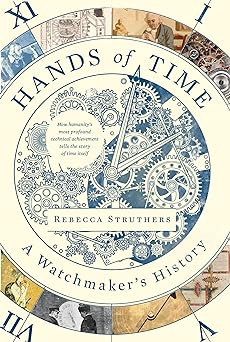
Hands of Time by Rebecca Struthers
Timepieces have long accompanied us on our travels, from the depths of the oceans to the summit of Everest, the ice of the arctic to the sands of the deserts, outer space to the surface of the moon. The watch has sculpted the social and economic development of modern society; it is an object that, when disassembled, can give us new insights both into the motivations of inventors and craftsmen of the past, and, into the lives of the people who treasured them.
Hands of Time is a journey through watchmaking history, from the earliest attempts at time-keeping, to the breakthrough in engineering that gave us the first watch, to today – where the timepieces hold cultural and historical significance beyond what its first creators could have imagined. Acclaimed watchmaker Rebecca Struthers uses the most important watches throughout history to explore their attendant paradigm shifts in how we think about time, indeed how we think about our own humanity. From an up-close look at the birth of the fakes and forgeries industry which marked the watch as a valuable commodity, to the watches that helped us navigate trade expeditions, she reveals how these instruments have shaped how we build and then consequently make our way through the world.
A fusion of art and science, history and social commentary, this fascinating work, told in Struthers’s lively voice and illustrated with custom line drawings by her husband and fellow watchmaker Craig, is filled with her personal observations as an expert watchmaker—one of the few remaining at work in the world today. Horology is a vast subject—the “study of time.” This compelling history offers a fresh take, exploring not only these watches within their time, but the role they played in human development and the impact they had on the people who treasured them.
However, as with every invention, there is a dark side to the watch. Thanks to the discovery of radium by Marie and Pierre Curie, hollowed out watch hands were filled with luminous paint. This new invention helped soldiers accurately see the time on their watches while sitting in deep, dark trenches. But it wasn’t only the battlefield that employed this new paint. Watch dials, aeroplane instruments, gunsights and ships’ compasses were also starting to glow.
Dial factories sprang up across the US, and also in Switzerland and the UK. To apply the expensive and precious radium paint to the narrow spaces on the watch hands, women in the dial factories stuck the extremely fine camel hair brushes in their mouths to bring them to a point. They were assured by management that the trace amounts of radium they were ingesting wasn’t harmful, but when you consider these women were paid in dials painted, it started to add up. Radium was touted as a cancer destroyer, but it also has no ability to distinguish between healthy tissue and cancerous. Therefore it began to eat away at the very bones of the women ingesting it. If you would like to read a harrowing and informative book on this topic, I would suggest the following.

The Radium Girls by Kate Moore
Discover the gripping and inspiring true story of The Radium Girls, a groundbreaking work by acclaimed author Kate Moore. Immerse yourself in this compelling narrative that unravels the extraordinary lives of these fearless women who fought against all odds.
The Curies’ newly discovered element of radium makes gleaming headlines across the nation as the fresh face of beauty, and wonder drug of the medical community. From body lotion to tonic water, the popular new element shines bright in the otherwise dark years of the First World War.
Meanwhile, hundreds of girls toil amidst the glowing dust of the radium-dial factories. The glittering chemical covers their bodies from head to toe; they light up the night like industrious fireflies. With such a coveted job, these “shining girls” are the luckiest alive―until they begin to fall mysteriously ill.
But the factories that once offered golden opportunities are now ignoring all claims of the gruesome side effects, and the women’s cries of corruption. And as the fatal poison of the radium takes hold, the brave shining girls find themselves embroiled in one of the biggest scandals of America’s early 20th century, and in a groundbreaking battle for workers’ rights that will echo for centuries to come.
With meticulous research and a keen eye for detail, Kate Moore delves into the lives of these remarkable individuals, capturing their resilience, strength, and unwavering determination. Through their stories, she exposes the shocking negligence and corporate cover-ups that plagued the radium industry, ultimately sparking a revolution in workplace safety.
The Radium Girls is a masterful blend of historical account and heartfelt tribute. Moore’s vivid prose brings these forgotten heroines back to life, ensuring that their sacrifices and triumphs are forever etched in our collective memory. As you turn each page, you’ll be captivated by their indelible legacy and inspired by their enduring spirit.
The Radium Girls is a must-read for history enthusiasts, feminists, and anyone seeking a remarkable story of resilience and empowerment.
One reason I love to read non-fiction is because it brings to life everyday objects we never think twice about, such as the watch. I hope you find this book as fascinating as I did.
 Mead Public Library Blog