
Dear reader, today I am going to talk to you about birds. I have been a huge bird nerd for years, and even started regularly watching a live bird cam while at work and enjoying conversation with other watchers in the cam’s chat feature. All on downtime of course! Wink wink.
When you think of migratory birds that come to Wisconsin in the spring and summer, what birds do you think of? The American robin? The red-winged blackbird? These are quintessential birds that herald the arrival of warmer weather! There is also the American goldfinch that, while it is a year-round resident of Wisconsin, the males turn from their yellow-brown coloring to a brilliant, unmistakable yellow that is easily spotted in trees and at bird feeders. Listen closely for their equally bright flight song as they fly around.
But have you thought of others? There’s the rose-breasted grosbeak, the yellow-rumped warbler, the eastern towhee, and the belted kingfisher, which all arrive roughly in late March and stay through September, or November in the case of the belted kingfisher. Have you heard of these birds before? Have you just read those names and thought to yourself, now what kind of bird is that? Well, dear reader, let me help you!
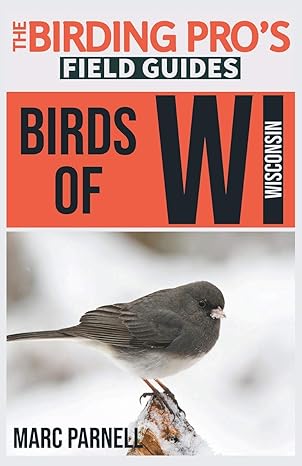
Birds of Wisconsin: The birding pro’s field guides by Marc Parnell
The Birding Pro’s Field Guide series introduces a number of innovative, never-before-seen features to the birding field guide scene. This highly accessible field guide gives the most complete description available for each species’ daily life and behavior, and each entry also includes a month-by-month birding forecast and a full page of highly identifiable color photographs. Perfect for novices and intermediates, but also serves as an invaluable reference for advanced birders. Featuring the 138 most common birds to Wisconsin.
Dear reader, you will see lots of books about birds with the phrase ‘field guide’ in the title or subtitle. These are books intended for use out in the woods, the neighborhood, or wherever else you happen to be and want to learn more about birds! Many of these field guides have sections describing a bird’s shape, call, behavior, habit, etc., that can help you narrow down exactly which bird you saw or heard. Sounds great doesn’t it? Many of these field guides are also pocket-sized, which works great for slipping into a purse or even a pants or jacket pocket.
But dear reader, you may be thinking, I have a bird feeder in my backyard and would like to learn more about the birds that visit it and the plants in my backyard. What about me?

All about backyard birds: eastern and central north america by Cornell Lab
A series of beginner-to-novice birding books, All About Backyard Birds is based on the Cornell Lab of Ornithology’s number one birding website allaboutbirds.org, which has had more than 21 million unique users to date.
All About Backyard Birds delivers best-in-class content and proven user-friendly formats. Each regional version―eastern/central North America and western North America―provides 120 of the most popular species and is filled with beautiful illustrations by Pedro Fernandes. With charts, maps, and other bird identification tools, All About Backyard Birds offers beginner birders the ideal way to start birding.
All About Backyard Birds also includes a tutorial for MERLIN®, an interactive GPS-based bird identification multimedia app (available in iTunes and Android stores and already used by more than 1 million birders), plus a FREE Bird QR book companion app. The app empowers users with a tap-to-listen birdsong function and gives more information about special topics throughout the book.
Dear reader, once you identify a new bird at your bird feeder there is no better feeling! In my opinion it feels like you’ve made a new friend and now have a regular visitor to look forward to. Also, once you identify a bird, you can tailor your birdseed to it, and even start planting native plants and flowers that the bird likes. Who knows? One day you may find yourself living in a birder’s paradise! That’s my dream anyway.
What about that Merlin app, you might be thinking? Dear reader, this app and others like it are a fantastic technological tool in the bird ID world! I have this app on my phone and I’ve used the recording function on it multiple times to record an unfamiliar bird song, or even help identify a new bird via a picture I took. This app also works great while on vacation, which being a bird nerd, is one of the things I most look forward to when visiting a new location. All the new birds I will hear and see!
However, even though I’ve mentioned birds that migrate to Wisconsin in the spring and summer, by all means your bird-watching adventures don’t have to stop once fall and winter come around! There is the small but adorable dark-eyed junco to look forward to each winter. These are gray and white birds that feed on the ground under feeders.

Wisconsin bird watching: a year-round guide by Bill Thompson
There are no state-specific books on how to appreciate birds and learn more about them. Like gardening, bird watching is a regional hobby, and the birds that frequent the backyards of Missouri differ from the birds found in Michigan. This series targets beginning and intermediate bird watchers from each Midwestern state.
The books are state-specific and highlight the birds that are found in each state. In addition to the profile, each bird entry includes a map to identity the specific range covered by the bird.
100 birds are presented via full-color photographs for accurate identification. Full-color seasonal section informs the reader of: the migrating birds that can be seen that month, the foods that attract those birds, the plants that can assist in attracting birds.
Dear reader, I hope I have inspired you to get outside and discover new birds, or even just to sit still for a moment and listen to the plethora of birdsong that exists in our world and our city. Happy birding, and as always, happy reading!
 Mead Public Library Blog