
Dear reader, since my last blog post I have become the unwitting owner of not two, not three, but six orchids! It all started with the original three I brought home from my brother’s wedding, and just recently three more that my sister-in-law gave me. Apparently once orchids bloom you need to cut them back and wait for them to produce new shoots. Patience is something my sister-in-law does not excel at it, so after saying the magic phrase – I’m thinking of throwing them away – I once again donned my Plant Recuser Hat and swooped in!
You see, dear reader, I have an affinity for the discarded, the forgotten, and neglected. Be it plant or inanimate object. For instance, several years ago I rescued a sock snowman my mom had made at a women’s church retreat back in the 90’s. He has a hole in the back that is sealed with a piece of tape, it’s a small hole but one she deemed enough for him to be thrown away. The audacity! I simply replaced the piece of tape and he still sits atop my wardrobe, peaceably containing his birdseed and still sporting his black buttons.
This same attitude follows me into the plant world. A while back someone at work was giving away aloe vera plants. Day after day I saw them sitting in the staff break-room with no home to call their own. Frankly, dear reader, I felt bad for them, so that’s how I ended up with three aloe vera plants and two snake plants vying for space on my desk. You won’t find me complaining, though, I love having plants around, whether they flower or not. In fact, I’m accustomed to most of my plants not flowering. But more on that later. We’re here to talk about orchids aren’t we?

Understanding Orchids by William Cullina
Orchids are the largest family of plants in the world. With 30,000 known species, you could acquire a different orchid every day for eighty years and still not grow them all. Back in the realm of reality, readers of this beautiful book can quickly and easily find the orchids that are right for them — which ones will thrive on a windowsill, which prefer artificial lights, and which need a greenhouse; which are for beginners, which for experts. And you can pinpoint the species within a particular genus that are the best ones to start with. Once you select your orchid, William Cullina’s authoritative guide explains what to do to keep it alive and healthy.
Featuring more than two hundred color photographs, Understanding Orchids covers everything you need to know to grow orchids successfully, whatever your level of interest or experience. With improved tissue-culture techniques making orchids more affordable, and the Internet making them readily available to consumers, growing orchids is more popular than ever: membership in the American Orchid Society has more than doubled in the last fifteen years. This is the book orchid fans have been waiting for.
From a quick Google search I learned that the most common commercially sold orchid is the Phalaenopsis orchid. I have no idea what kind of orchids I have at home, but I can almost guess that they are this kind, since my sister-in-law bought them at Walmart.
Isn’t it interesting how there is always random facts circulating around that you’ve heard one way or another? This is the case with the fact that you can water orchids with ice cubes. Maybe you’re nodding your head right now, because you’ve heard that too. I always thought that was bizarre! And frankly it was one of the reasons why I vowed to never own orchids. Watering with ice cubes, it just seems so exotic and strange. Yet dear reader, here we are, I now have six orchids! Life is funny sometimes, isn’t it?
I’ve heard it both ways. I’ve heard that the ice cube method keeps orchids alive just long enough for them to bloom and then they die, but I’ve also heard that it was developed by orchid growers so the average person doesn’t accidentally overwater their orchid and kill it! Well, dear reader, I can tell you emphatically that I’ve been using the ice cube method exclusively and my orchids are still alive! Researchers at the Ohio State University of Georgia published a study on the impact of watering orchids with ice cubes and they found that it is completely safe. I will link the results of the study here, but to paraphrase, ice cube watering helps the orchids take in water more slowly, it did not adversely affect the temperature of the roots, and lastly it did not affect flower longevity or display.
While I love plants, I also know my weakness as a plant owner, which is I forget to water them! This is why I tend to gravitate toward succulents and other such forgiving plants. Also – shame! – I tend to gauge how long it’s been since I watered them by how wilted they are. I usually have a family watering day when this happens, everybody in the pool! Anyway, more books about orchid care! That’s why you’re here, right?
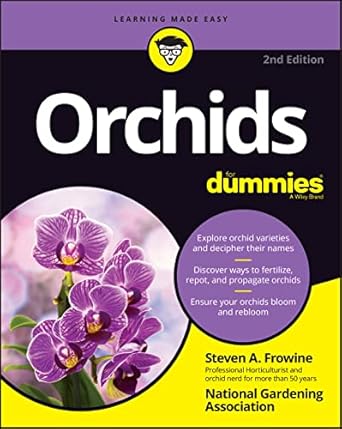
Orchids for Dummies by Steven A. Frowine
Orchids display more beautiful and exotic flowers than you’ll find on other flowering plants, but they do require some love and care to grow well. With help from Orchids For Dummies, anyone can be successful in growing and flowering these gorgeous and fragrant plants in their garden or home!
This step-by-step guide shows you how to select orchids that will thrive in your own unique environment and how to water, fertilize, repot, and propagate them on your own. You’ll learn to decipher complicated orchid names (“phalaenopsis,” anyone?) and create spectacular displays. You’ll also discover:
- New information about updated plant and orchid classification systems so you can know what to buy at your local garden center or store
- Expanded info on moth orchids, one of the most popular varieties of the plant sold in the world today
- Updated instructions on which pesticides, fertilizers, and potting materials you should be using
Perfect for amateur gardeners, orchid-lovers, and anyone interested in growing these exquisite flowers on their own, Orchids For Dummies will turn your thumb green in no time at all!
Dear reader, I have never fertilized or otherwise done anything extra to my plants – remember what I said about being accustomed to my plants not flowering? – so I didn’t put the above book on hold with the intentions of starting that. I simply want to know how to keep my newly acquired orchids from dying so they can continue to grace my living spaces. If I was a more forward-thinking person I would have put this book on hold months ago so I could extol its virtues to you, but alas, I am not that person. You’ll just have to find out it’s qualities – good or bad – for yourself! Venture forth into the world of orchid books, I dare you!

The Orchid by Luigi Berliocchi
The orchid is the most evocative of flowers, inspiring in some of its admirers a fanaticism akin to madness, as recently demonstrated in Susan Orlean’s The Orchid Thief. This elegant survey of the orchid treats its place in legend and suggests the impact that these exotic plants, whose “exuberance and heavy, sensual beauty . . . seemed to bear witness to some original sin.” Berliocchi chronicles the adventurers and scientists who introduced these marvels, discusses their place in the arts, from literature and magic to cuisine, and concludes with accounts of the most important genera and their cultivation. Splendidly illustrated with period engravings and botanical paintings, it is literate and delightful.
According to the above book, it has been estimated that of the world’s twenty-five thousand orchid species, at least four hundred were used regularly for healing purposes. Very often, the cure was no more than a placebo, but research has suggested that some orchids may contain a number of valuable active principles. For instance, extract of Dactylorhiza maculata was still prescribed in Europe at the beginning of the nineteenth century as a treatment for tuberculosis. In addition, members of the genus Bletilla were highly valued in China, Japan, and Tibet for their euphoric and blood-purifying properties.
Dear reader, I hope after reading my blog post the idea of owning an orchid and taking care of it isn’t as daunting as it once was. If I can keep six of them alive, so can you! In fact, I inspected one on my dresser top this morning and I can assure you it has a new bub coming! Having plants in your living space is a comforting and rewarding experience, much like living with books!
 Mead Public Library Blog